
Why they exist
Language models predict text. That's great for writing and poor for anything with exactly one right answer and no pattern to predict it from: long sums, counting the letters in a word, the number of days between two dates, unit conversions, random picks. So every model that can use tools gets six small ones that work these out on your computer.
They're in every chat and in quick-ask. They take milliseconds and cost nothing. The model decides when to use them, and the answer's work line shows each one: Calculated, Counted, Worked out 3 results. Click it to see what went in and what came out.
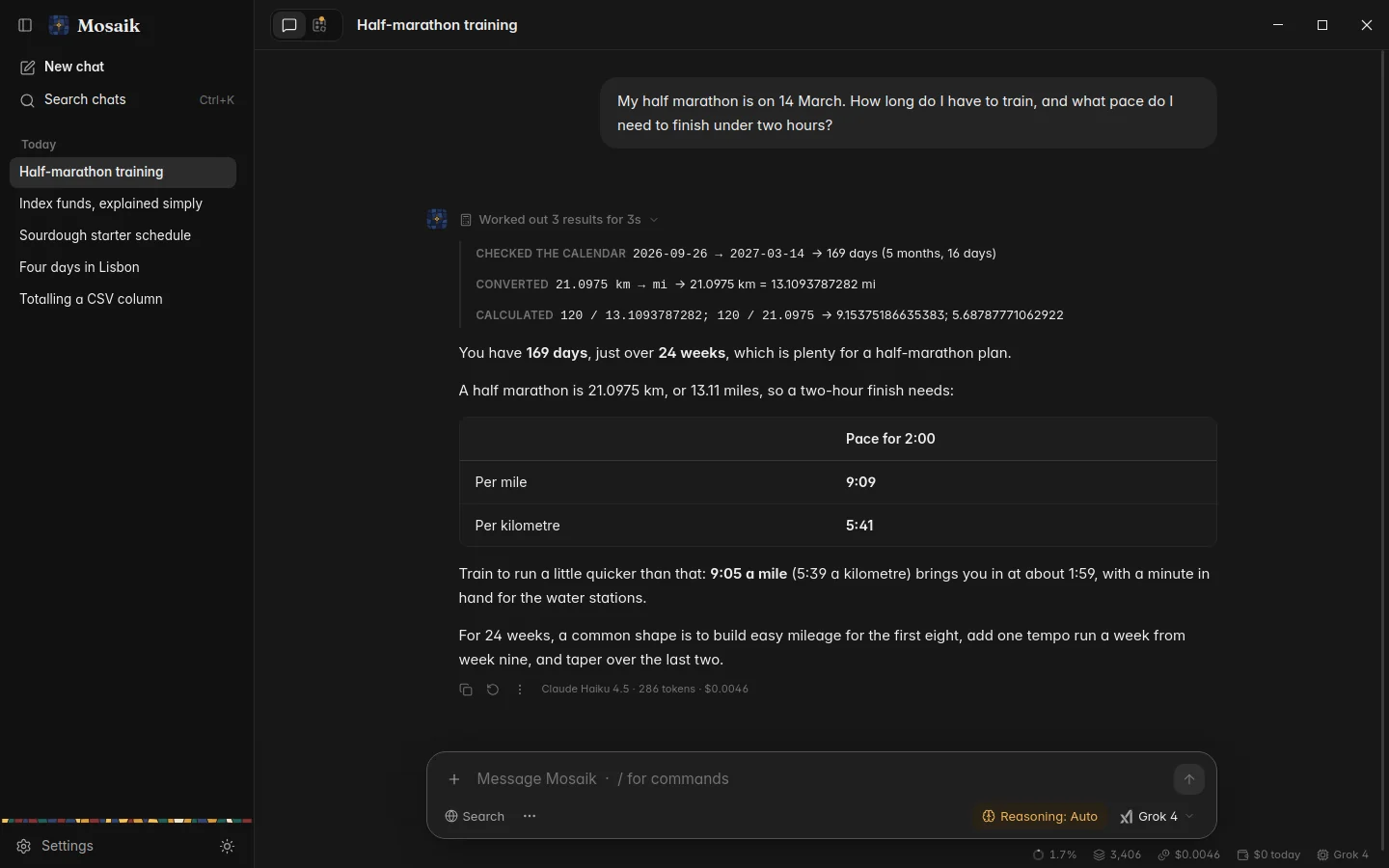
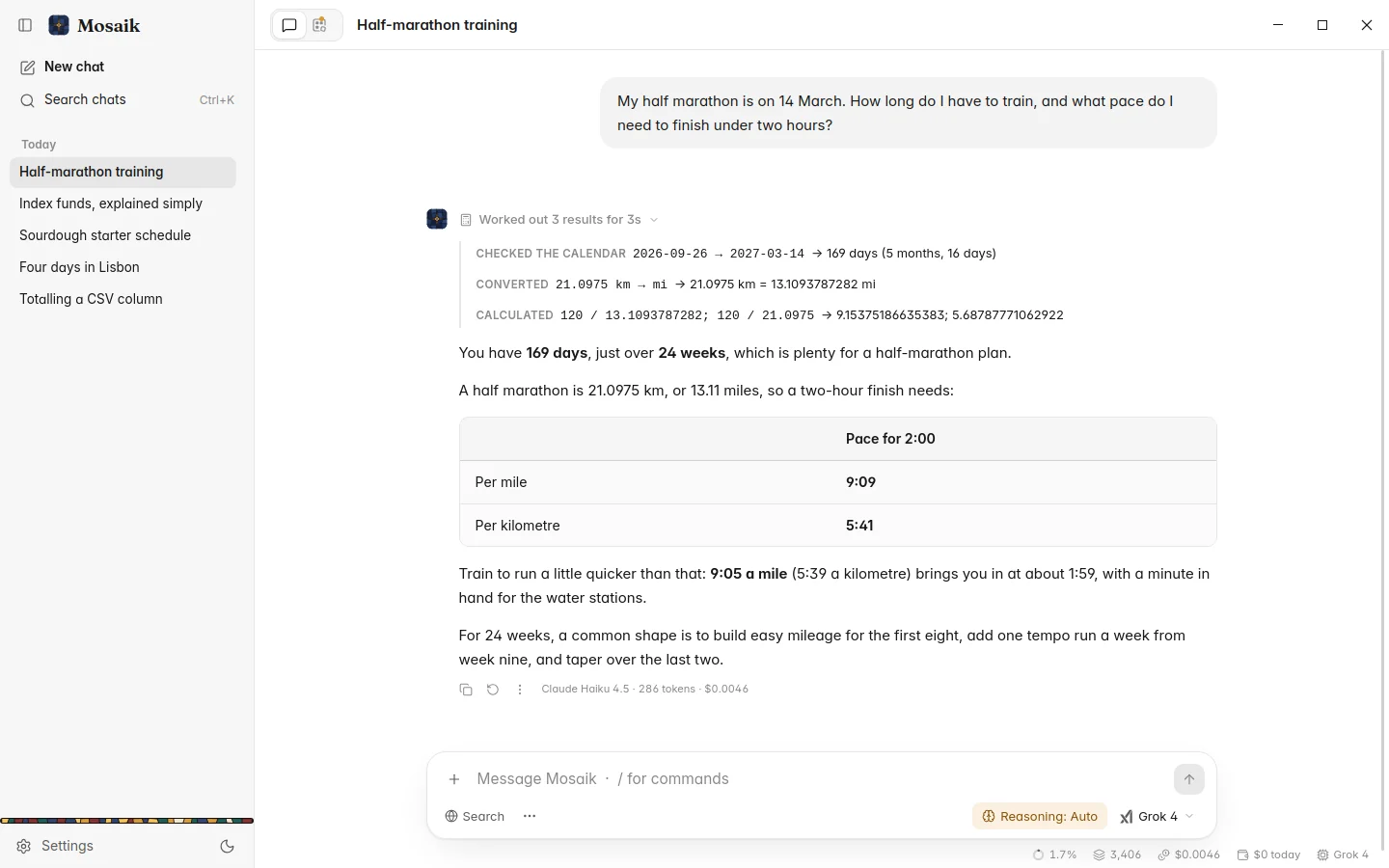
The six tools
| Calculator | Exact arithmetic. Integers of any size, fractions that stay fractions (0.1 + 0.2 is 0.3), comparisons like 9.11 > 9.9, roots, logarithms, trigonometry, primes, factorising and combinatorics. |
|---|---|
| Text counter | Characters, letters, words, sentences and lines. How often a letter or phrase appears and where. Spelling a word out, reversing it, checking palindromes. |
| Date and time | Today's date and time, the days between two dates (business days too), adding weeks or months, the weekday of a date, and converting between time zones. |
| Unit converter | Length, weight, volume (US and imperial), area, time, speed, data (GB and GiB), energy, power, pressure, angle, frequency and temperature, from exact definitions. |
| Random picks | Numbers, choices, shuffles, coin flips, dice and tokens, from Windows' own random source. |
| Python | Anything else that needs computing, in a locked-down Python (below). |
Models that can't use tools answer the way they always would. The model browser marks them No tools.
The Python sandbox
When the model runs Python, Mosaik starts a separate Python process for it, in an empty temporary folder, with a time limit (10 seconds by default, 30 at most) and a 512 MB memory ceiling. Before the code runs, it's checked:
- It can only import maths, text, date, data-structure and hashing modules.
- It has no way to open files, reach the network or start other programs.
- The usual back doors out of a restricted Python, such as
eval,execand names starting with an underscore, are refused.
Think of it as a calculator with loops. It exists so a model can crunch numbers without going anywhere near your files or the internet.